
Industrial Workforce Reskilling 2030: The Human-Centric Factory
The industrial landscape is undergoing fundamental transformation. By 2030, AI and automation will reshape 86% of businesses, yet the focus is shifting from replacement to human-machine collaboration. In automotive and wind energy, 59% of workers require reskilling for technological and environmental transitions. Discover how MULTIMOLD's AI-powered approach addresses this challenge and what it means for your sector's future.
.jpg)
A New Paradigm for Industrial Operations
For years, the prevailing narrative surrounding industrial automation has been dominated by a zero-sum perspective: a future in which humanoid robots and sophisticated algorithms systematically eliminate human workers from industrial operations. However, as we approach 2030, this paradigm is undergoing fundamental revision.
The World Economic Forum's Future of Jobs Report 2025 provides empirical evidence for this transition, demonstrating thatwhile 86% of employers anticipate AI-driven business transformation, the prevailing trend is not workforce replacement but rather a comprehensive geoeconomic realignment. Within the automotive, wind energy, and aerospace sectors, we are observing the emergence of a "Human-Machine Frontier"where in technology serves as the foundation for substantial industrial restructuring rather than a strategy for workforce elimination.
Stabilisation of skills disruption: an evolving workforce landscape
One of the most significant counterintuitive findings in recent workforce analytics is the stabilisation of"skill instability" — the rate at which existing jobcompetencies become obsolete — despite continued technological acceleration. While skill instability reached 44% in 2023, it declined to 39% in 2025.
This reduction is not attributable to technological deceleration but rather to workforce adaptation. We are witnessing a "stabilisation of disruption" driven by substantial increasesin training completion rates: 50% of the global workforce has engaged in upskilling initiatives, up from 41% two years prior. Nevertheless, the magnitude of the remaining transition presents a considerable industrial challenge.
"If the world's workforce was made up of 100 people, 59 would need training by 2030 to navigate the current technological and environmental transitions. Of these, 11 are unlikely to receive the reskilling they need, leaving their prospects at high risk."
The "Sovereign Factory" and strategic reshoring initiatives
The era of hyper-globalisation has been superseded by what may be termed the "Sovereign Factory." Geoeconomic fragmentation, identified by 34% of employers as a transformative force, is precipitating a substantial shift toward domestic or strategically aligned manufacturing locations. Table 2.1 of the report identifies a critical trend: employers affected by trade restrictions demonstrate a 50% higher probability of planning reshoring initiatives compared to the global average.
This transition extends beyond the physical relocation of manufacturing assets: it encompasses the strategic protection of reshored supply chains against geopolitical disruptions. This shift is generating demand for a new category of specialised roles: Security Management Specialists and Supply Chain and Logistics Specialists.These positions function as the operational resilience framework of the sovereign factory, mitigating risks associated with three primary fragmentarytrends:
- Increased restrictions on global trade and investment (affecting 55% of the Mining and Metals sector)
- Increased government subsidies and industrial policy (a major driver in Advanced Manufacturing)
- Increased geopolitical division and conflict
The Green Transition as primary driver of Industrial Employment
While artificial intelligence dominatespublic discourse, the green transition represents the primary engine ofstructural labour market transformation. In the automotive and aerospace industries, 71% of employers anticipate carbon-reduction mandates as the most transformative force for their operations by 2030. This is generating adual-speed growth model within the industrial sector.
The industrial landscape is experiencingbifurcation: in percentage terms, "Autonomous and Electric Vehicle Specialists" and "Renewable Energy Engineers" rankamong the fifteen fastest-growing roles. However, in absolute terms, the greeneconomy's impact is most evident in "Farmworkers, Labourers, and Other Agricultural Workers," with projections indicating 35 million new positions—driven primarily by the intersection of climate adaptation requirements and expanding digital accessibility.
The Automation Versus Augmentation Paradigm
The evolution of the human-machine frontier demonstrates significant sectoral variation. Globally, the proportion of work tasks performed by humans is projected to decline from 47% to 33% by 2030. However, the mechanism by which this 14% reduction occurs has profound implications for workforce prosperity. Sectors such as insurance are pursuing"automation" strategies (95% replacement of human tasks), whereas government and medical sectors prioritise "augmentation" approaches (human-machine collaboration).
The industrial sector confronts a more complex paradigm. In sectors such as oil and gas, the "automation share" exceeds 100%, indicating that technology is not merely replacing discrete human tasks but is encroaching upon collaborative functions. In the automotive and aerospace sectors, the proportion of standalone human task reduction attributable to automation reaches 46%.
"As an increasing amount of afirm's total economic value creation is derived from advanced machines andproprietary algorithms, the critical question remains: to what extent willhuman workers be able to share in this prosperity?"
Core Competencies: The New Industrial Skill Requirements
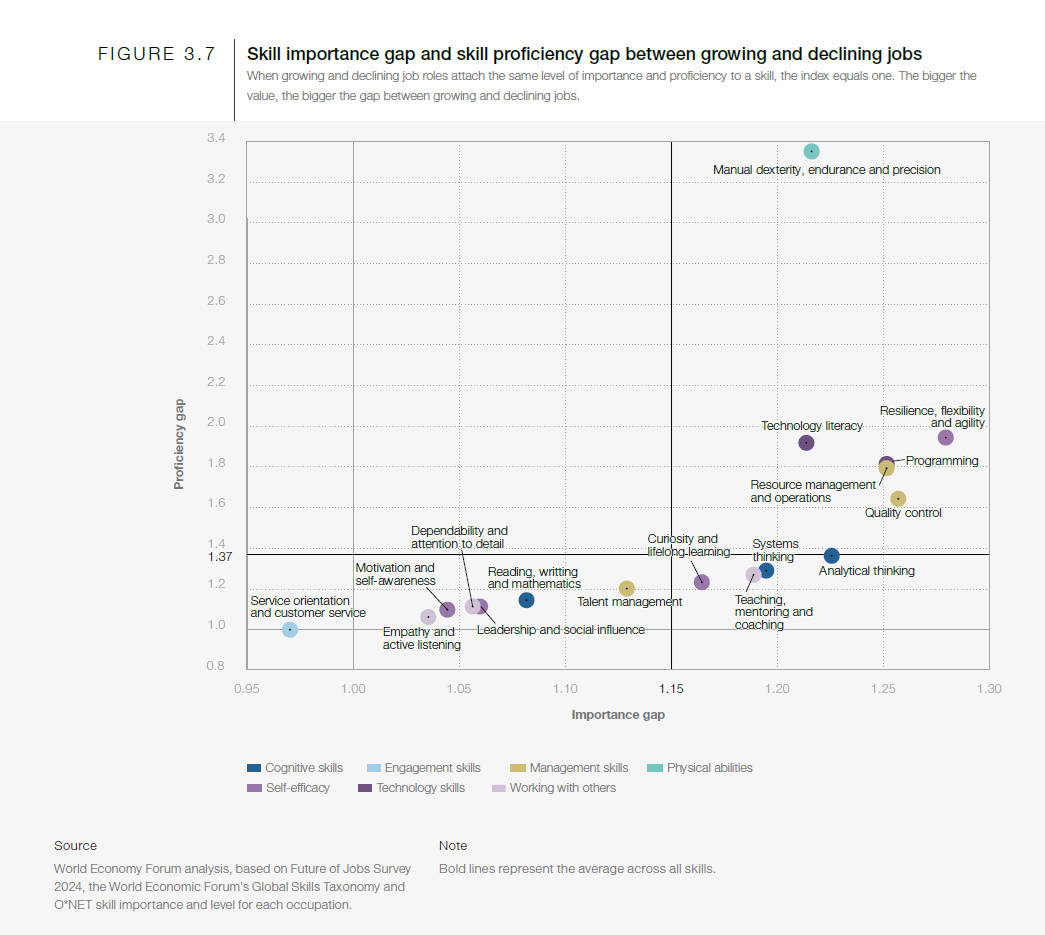
The industrial worker of 2030 will be evaluated based on cognitive capabilities rather than manual dexterity —the latter representing one of the few skill categories experiencing net decline. The "Proficiency Gap" (Figure 3.7) demonstrates that emerging roles require approximately double the proficiency in programming and technological literacy compared to declining roles. Most significantly, Resilience, Flexibility, and Agility have emerged as the primary differentiators in both importance and proficiency requirements.
Top Five Core Competencies for the 2030 Industrial Worker:
- Analytical Thinking (Essential for 70% of organisations)
- Resilience,Flexibility, and Agility (Primary differentiatorfor emerging roles)
- Leadership and Social Influence
- Creative Thinking
- Technological Literacy
Strategic and Responsible AI Integration
Organisations are transitioning from fragmented AI experimentation toward strategic adoption, positioning the technology as an indispensable tool that reduces operational complexity without diminishing human value. Emerging capabilities such as "Agentic AI" and natural language-based development environments are democratising technical work, enabling employees to create applications and execute objectives through natural language interfaces. Effective implementation requires prioritisation of change management and comprehensive employee support, as inadequate attention to these areas risks resistance from middle management who may perceive AI as threatening rather than enabling.
Successful integration ultimately depends upon establishing cross-functional governance frameworks to ensure transparency and prevent organizational silos, fostering an institutional culture where in AI serves clearly defined, human-centric objectives.
Strategic Implications: The Question of Human Value Proposition
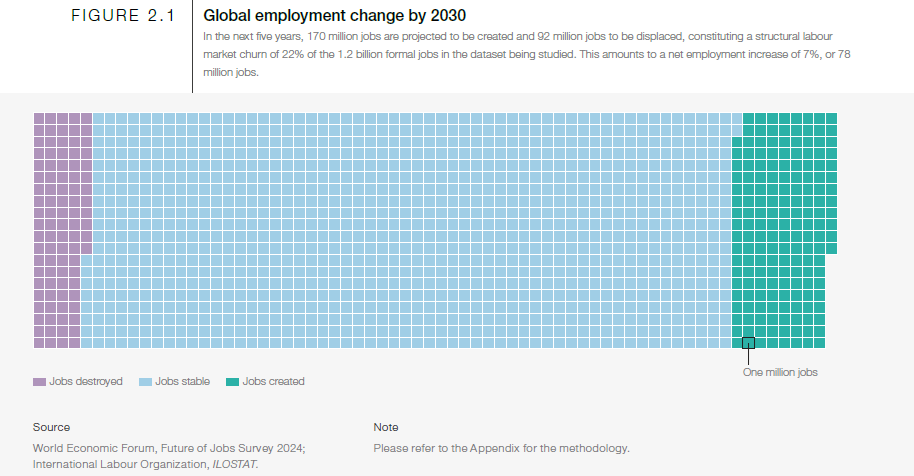
We are entering a period of substantial structural transformation: 170 million new positions are projected to emerge, while 92 million will be displaced. While aggregate projections indicate net employment growth, the operational reality presents significant challenges. The 11% of workers "unlikely to receive reskilling" represent not merely a statistical cohort but rather a population at elevated displacement risk due to structural barriers.
As we engineer the industrial facilities of 2030, we must advance beyond metrics focused solely on machine efficiency.In an operational environment where humans may perform only 33% of standalonetasks, the fundamental strategic question for industrial leadership is: How do we operationalise "human-centric" manufacturing such that the Sovereign Factory remains an environment of human prosperity rather than merely a high-efficiency automated system?
MULTIMOLD Initiative: bridging the Skills Gap through AI-enabled training
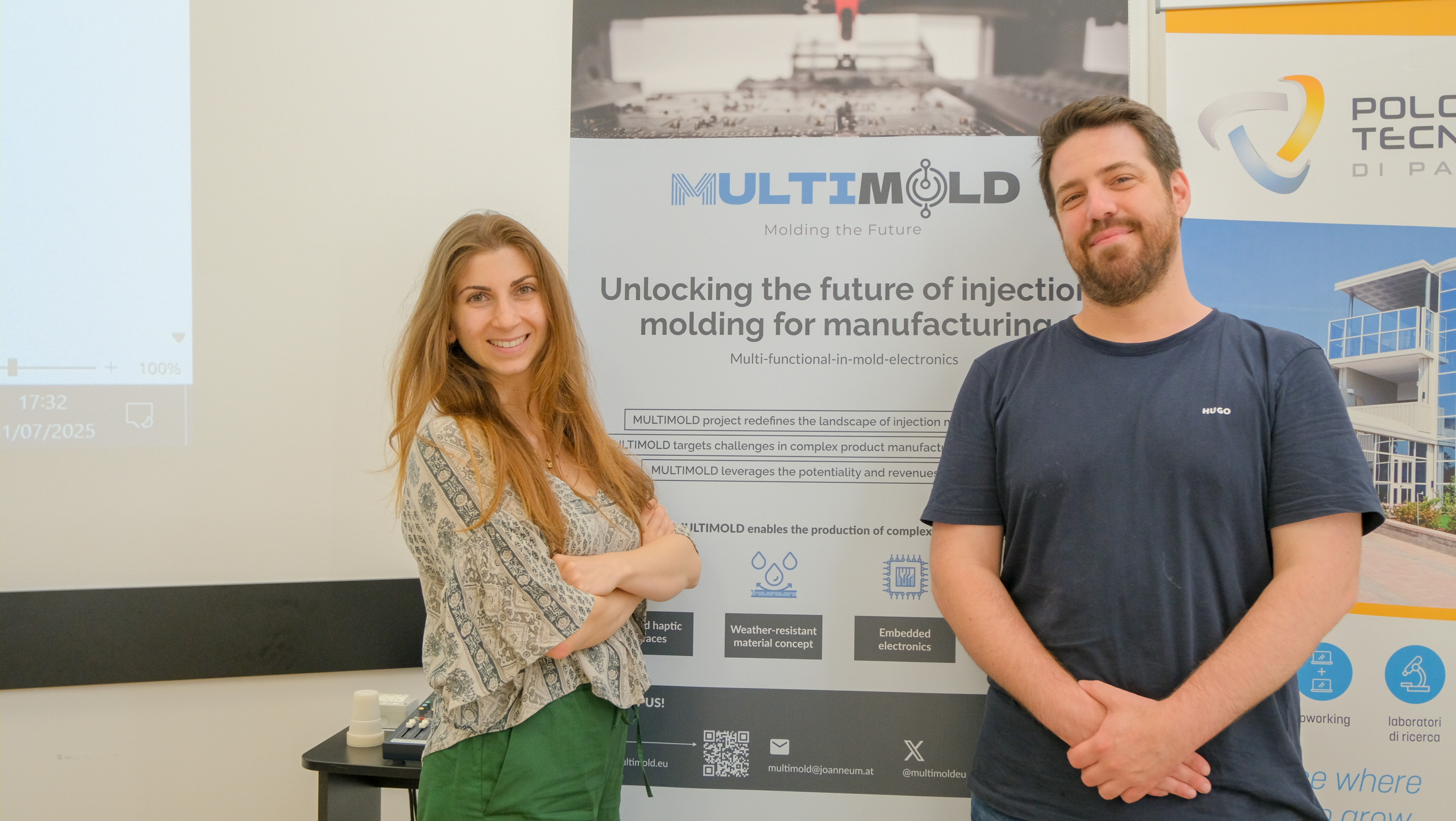
The MULTIMOLD project is actively addressing the upskilling and reskilling requirements in the automotive, wind turbine,and industrial sectors through the deployment of advanced workforce developmenttools.
Central to this initiative is AVANTI,an AI-powered software platform developed by R2M Solution that performs comprehensive curriculum vitae analysis to identify competency gaps for specific positions and recommends targeted training interventions. This technology-enabled approach allows organisations to systematically assess workforce capabilities against evolving role requirements and design precision training programs that address identified deficiencies.
AVANTI is currently undergoing validation testing with researchers and industrial personnel participating in the MULTIMOLD project. This pilot implementation will provide empirical evidence regarding the platform's efficacy in identifying skills gaps and facilitating targeted reskilling initiatives, directly supporting the human-centric industrial transition outlined throughout this analysis. By leveraging artificial intelligence to enhance rather than replace human capability development, MULTIMOLD exemplifies the augmentation paradigm essential forensuring workforce prosperity in the emerging industrial landscape.
Read our publication "A Seamless ChatGPT Knowledge Plug-in for the Labour Market"
-
.png)
.png)




.jpg)


